
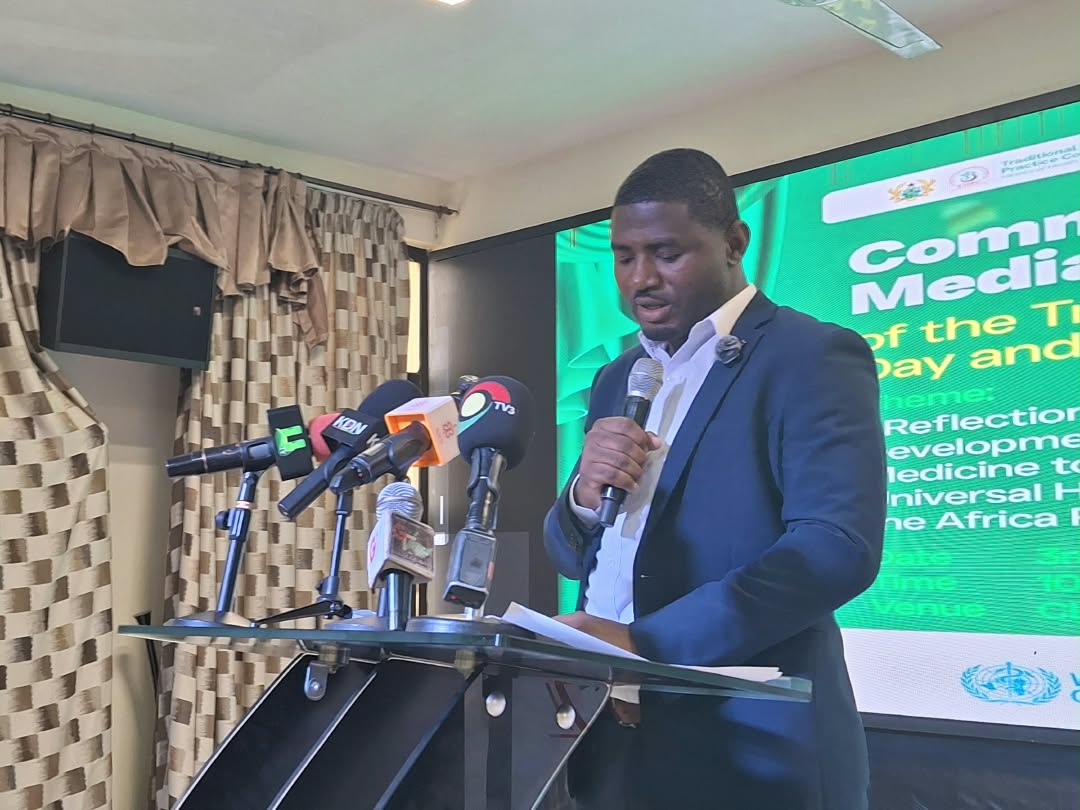
The Traditional Medicine Practice Council (TMPC) held its Media Launch on 3rd September, 2026, to commemorate this year’s Traditional Medicine Week Celebration, sending a clear message to the nation: The Council’s twenty-five-year mandate to regulate and safeguard traditional medicine in Ghana is being carried out with renewed urgency, and the results are beginning to show.
Speaking at the Media Launch, the Acting Registrar of the Traditional Medicine Practice Council (TMPC), Dr. (MH) Yakubu Tobor Yusuf, reminded the gathering that traditional and herbal medicine is not a marginal practice in Ghana, but a mainstream one that is relied upon by close to seventy percent of the population as part of their primary healthcare, and generating close to two billion cedis a year, with more than one hundred thousand registered practitioners and an entire value chain of farmers, harvesters, processors, and retailers depending on it.
Research as The Bridge Between Tradition and Trust
A central theme of the address was the role of research in turning traditional knowledge into medicine the world can rely on. Dr. Yakubu cited the global example of artemisinin. This leading malaria treatment began as a centuries-old herbal remedy before rigorous science confirmed its value, as did the case of the Madagascar periwinkle, source of the drugs that made childhood leukemia a survivable disease. “Traditional knowledge is the beginning of the discovery, not the end of it,” he said, urging the country to validate its own medicinal plants rather than wait for others to do it first. This is echoed in this year’s international theme, “Reflection on Research and Development Efforts of Traditional Medicine towards Achieving Universal Health Coverage in the African Region.”
A year of measurable progress
The Council reported that, over the past year, registration and renewal of practitioners had more than doubled, a backlog of over two thousand licenses and certificates had been cleared, and compliance teams had inspected more than five hundred facilities nationwide, closing those operating without a license or with unqualified staff.
“Standards are not made in conference halls; they are made in the field,” Dr. Yakubu noted. Nineteen Council offices are now active across the country, including new regional offices in Sunyani, Nalerigu, and Cape Coast, alongside mobile payment services and a national digital practitioner register under development.
On training, the Acting Registrar highlighted the growth of university-level herbal medicine education to the doctoral level at institutions including KNUST, Pentecost University, and Central University, alongside a new community-based curriculum being developed for indigenous practitioners — herbalists, bone setters, birth attendants, and spiritual healers which will be delivered in local languages and to credit years of practical experience. “No practitioner left behind,” Dr. Yakubu affirmed, describing this as the guiding principle of the initiative.
On research and product development, the Council pointed to ongoing collaboration with KNUST and Central University, supported by development and industry partners, to produce standardised, evidence-based herbal products for hypertension and pain management products intended to follow a clear regulatory pathway toward eventual consideration for National Health Insurance coverage.
A call to the sector, and to the public
The Acting Registrar closed with an appeal to every stakeholder in the sector: practitioners were urged to register, renew, and display their licenses; the media was asked to verify claims with the Council before amplifying them; researchers and universities were encouraged to continue validating traditional remedies; and members of the public were reminded to ask to see a valid license before receiving treatment. “This medicine is yours,” Dr. Yakubu told the gathering, adding a call to the country’s youth to look closely at the plants around them, “the next artemisinin may be growing in it.”
The address closed on a note of resolve: “We hear you. We are working. And the call is being answered.”
The 3rd September Media Launch marks the beginning of a season of activities under this year’s Traditional Medicine Week Celebration, which will culminate in a national practitioners’ conference later in the year, alongside celebrations of the Council’s Silver Jubilee.
0 Comments